
Expert Insights: September 2026
Quality Considered in Advance
How explainable AI identifies scrap risks in electroplating systems before coating begins
In electroplating processes, quality results from the interaction of many small influencing factors. If a deviation is detected only after coating, material, energy, chemicals, and equipment time have already been consumed. At that point, inspection can only identify the damage rather than prevent it. Data based quality prediction takes an earlier approach by assessing the risk associated with a specific load before the value adding process begins. For practical use, the decisive factor is not so much the computational power of the model as its interpretability.
The defect becomes visible at the end, but its causes arise earlier
Traditional final inspection performs an essential function. It separates conforming parts from defective parts and provides evidence that specifications have been met. However, its timing is inevitably late. Once a batch has already passed through pretreatment, activation, coating, and post treatment, inspection can only assess the result of the resources already consumed.
This distinction is particularly relevant from an economic perspective in electroplating because component quality does not depend on a single target value but on an entire process chain. Part geometry, surface condition, rack or barrel loading, bath condition, temperature, current and time profiles, dosing, transport and waiting times, as well as the sequence of preceding orders, all influence one another. A temperature may remain uncritical as long as the dwell time is appropriate. Bath chemistry may appear stable until a particular part, an unusual load, or a specific production sequence is introduced. Small deviations are often inconspicuous when considered individually and only become relevant to quality when they occur in combination.
The central question is therefore not: How can scrap be detected more quickly? Instead, the question is: How can an increased risk of scrap be identified while corrective action is still possible?
Well researched, but not in surface finishing
The term Predictive Quality has become established for this approach. It refers to the use of machine learning in manufacturing to estimate product quality from process and product data and to derive insights that can improve quality. The breadth of this field is illustrated by a systematic review that evaluated 81 scientific publications from 2012 through 2021 and classified them according to the manufacturing processes defined in DIN 8580 [1].
The results of this classification are noteworthy for our industry. Twenty-six studies addressed separation processes, 14 addressed joining processes, and 10 each addressed primary shaping and forming. Only 4 studies addressed the main category of coating, and those 4 examined Chemical Vapor Deposition, painting, paint application, and adhesive dispensing. Electroplating does not appear at all. Multistage process chains, which include virtually every electroplating operation, are also scarcely represented, with only four studies.
Surface finishing is therefore not an over researched field but one that remains largely unexplored. This is not due to a lack of relevance, but rather to the focus of previous research. Only 11 of the 81 studies used data from actual production operations. Most relied on experimentally generated data sets under fixed conditions, with a median size of only 144 observations. As a result, the conditions found in real production systems, including numerous influencing factors, few defect cases, and changing part types, are underrepresented. For electroplating companies, this leads to two conclusions. There is no ready made solution available in the literature, and companies that systematically use their own data are entering a field that is still largely unexplored.
Large amounts of data, but no decision yet
Modern systems already generate a broad data foundation. Control systems record process steps, measured values, transport movements, and messages. ERP and MES systems contain information about parts, orders, quantities, and routes. Quality assurance documents inspection results and defect patterns. Nevertheless, these sources remain separate in many companies. Storing data alone does not improve quality.
For predictive assessment, the data must be clearly assigned to a specific load, meaningfully aggregated over time, and linked to a reliable quality result. Only then does a data set emerge that can be used for learning and that simultaneously answers three questions: What was produced, under what conditions was it produced, and what was the actual result?
The challenge lies less in any spectacular individual value than in the dimensionality of the data. Numerous sensors generate time series, which in turn produce characteristics such as averages, variations, minimum values, maximum values, and characteristic profiles. This type of aggregation is standard practice in the technical literature and not merely a workaround. Even a moderately sized system can therefore produce several thousand potential influencing variables. A second and often underestimated challenge is that scrap is rare. This is desirable from a business perspective but inconvenient for machine learning because the defect cases that contain particularly valuable information are significantly underrepresented. AI models that depend on large and balanced data sets can quickly reach their limits under these conditions.
Explainability is not an optional feature
In production, a warning alone is not sufficient. A system that classifies a load as critical must present its assessment in a way that technical experts can review. This is not merely a matter of acceptance but also of operational reliability. Process owners must be able to determine whether the identified influencing factors are plausible, whether a special case exists, or whether the model is missing information that is known within the operation.
Current research has generally moved in a different direction. In 2020 and 2021, 38 percent of the primary models used were multilayer neural networks and 30 percent were Convolutional Neural Networks. Together, these difficult to interpret methods accounted for more than two thirds of the models. AI models whose logic can be understood directly played only a marginal role. For applications with significant consequences, this choice of model is increasingly being questioned. Interpretable models do not necessarily require a loss of accuracy, and the decision to forgo interpretability is often made too readily.
For this application, AI models are therefore particularly suitable when they can express their assessments through logic that can be reviewed. Such models capture interactions and nonlinear effects while revealing which conditions lead to an increased risk assessment. What is new is not the underlying concept but the way these models are trained. Traditionally, such models are constructed step by step according to local criteria. More recent methods train them so that the best overall solution is found within a specified complexity limit. There is a reason why this has only recently become practical. Complete optimization is computationally difficult, a fact that has been known and mathematically demonstrated since the 1970s. Only modern computing power and new optimization methods have made the problem manageable. The actual challenge is therefore not the concept itself but scalability to several thousand influencing variables.
How much model complexity can a person understand?
The fact that a model is interpretable in principle does not necessarily mean that it will be understood in an industrial environment. Empirical studies involving users have examined which characteristics of interpretable AI models actually determine their comprehensibility and have produced two findings that are directly relevant to industrial system engineering.
The overall size of a model matters less than the effort required to answer a specific question using that model. This aspect is usually overlooked in the technical literature. The total number of individual conditions contained in the model becomes relevant only for larger models. A sparse model is therefore not only computationally manageable. Its explanation can also be understood by the operator using the system controls. A model is only as explainable as the way its results are presented at the system. Ultimately, explainability is also a user interface challenge, not merely a property of the underlying method.
What an accompanying study demonstrated
Aucos investigated this approach together with Maastricht University as part of an academic research project using real process and quality data from an electroplating operation. The data set was intentionally challenging. It contained several thousand continuous features from more than 40 consecutive treatment steps, together with a pronounced imbalance between conforming and defective parts.
Two results are particularly relevant to industrial practice. First, compact, fully optimized models with very low complexity achieved a better balance between detection accuracy and false alarms than substantially larger models trained using conventional methods. A model whose explanation could be reviewed by a technical expert within one minute was therefore not a compromise but the better solution. Second, the advantage was greatest precisely when only limited training data was available. For new systems or new groups of parts whose software cannot be updated every month, this is a critically important practical characteristic.
This finding is not isolated. Independent comparative studies across several hundred data sets support the conclusion that fully optimized models outperform conventionally trained counterparts when a complexity limit is imposed. On average, the difference is moderate, but in individual cases it can be substantial.
The path to these results was equally instructive. A considerable portion of the effort is devoted not to the model itself but to determining which signals actually contain useful information. Constant measurements, redundant variables, implausible sensor values, and process characteristics without a meaningful relationship to the load must be identified and removed. The quality of the model therefore begins with the quality and technical interpretation of the data.
Quality feedback is the fuel for the model
Every prediction requires a reliable reference point. The model must know which loads actually achieved the required quality and which loads produced defects. This requires structured feedback from quality assurance. Free text entries and inconsistent defect descriptions are usually understandable to people but are only of limited use for systematic learning. Defined quality classes, traceable defect categories, and an unambiguous assignment to the batch or load are more suitable.
Feedback in the opposite direction is equally important. Operators and quality assurance personnel must be able to confirm or correct predictions and add information about special causes. This creates a continuous cycle of prediction, technical decision making, production, inspection, and renewed learning.
Pretrained through domain knowledge, refined at the system
An AI model for electroplating should not start from zero. The processes are too specific, the influencing variables require too much technical expertise, and the amount of data available from an individual system is initially too limited. Aucos AG therefore follows a two stage approach. Models are initially structured and pretrained based on many years of experience with surface finishing systems. This pretraining provides an understanding of which variables may be relevant in electroplating processes and how industrial systems typically behave.
Figure 1 shows a typical zinc nickel process and indicates which process steps can have a significant effect on the final quality result. Aucos expertise in surface finishing makes it possible to classify and weight model results directly according to the specific process. This creates a realistic and process specific model that can provide fundamental insight into the process steps that determine quality even before deployment at the individual system.
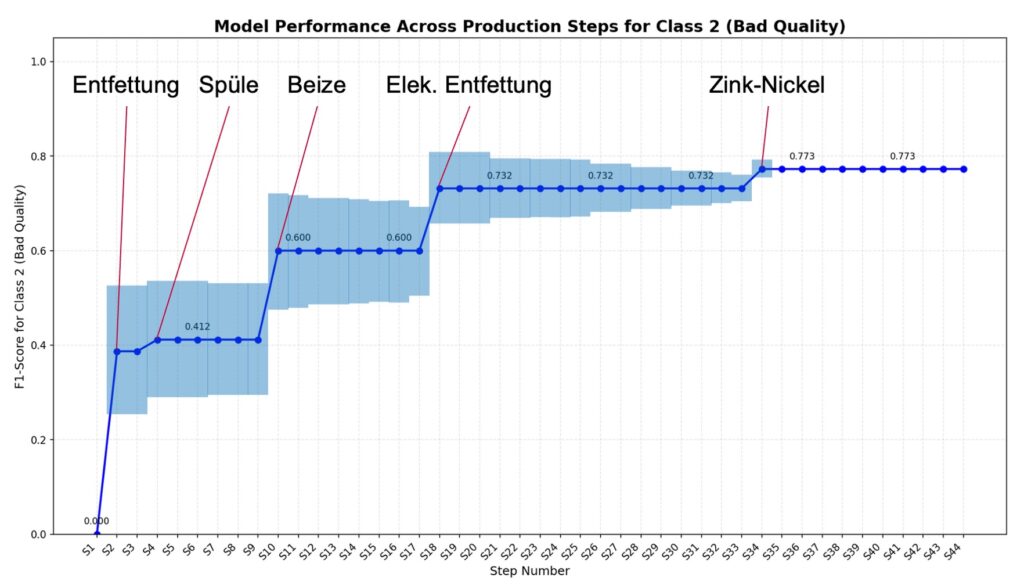
Abbildung 1
The actual precision is then developed on site. Every system is different. Parts, process sequences, baths, racks and barrels, automatic system behavior, operating procedures, and quality criteria vary. Only additional training on the specific system transforms a general foundation into a robust model for actual operation. This also addresses a known weakness of many published studies. Their models generally apply to a single product type, while the question of transferability remains unresolved. The best model is developed where it will operate because that is where the data that truly matters is generated.
The right time: before resources are consumed
Risk assessment provides the greatest benefit when it is available before the load enters the system or at least before the critical coating step begins. The assessment then applies not to the part master data in general but to the specific situation: this load, this route, this system condition, and this process history. The result is neither a guarantee nor an automatic blocking command, but a probabilistic early warning.
When the risk is elevated, the responsible person can investigate specific factors. Are the bath conditions or system conditions unusual? Is the load unusual? Should a process step be adjusted, an additional measurement performed, or the order scheduled during a more favorable time window? Above all, AI provides time for an informed decision. It does not replace process responsibility but moves the availability of relevant information to an earlier point in the process.
This is precisely where the largest gap between research and industrial practice becomes apparent. Most methods are trained offline, evaluated offline, and used offline. In practical applications, however, integration into the online system is where the actual value is created. A model that displays a result in an analysis tool after the shift has ended does nothing to change the scrap rate.
From individual warnings to integrated production planning
As an isolated status indicator, a quality prediction system does not realize its full potential. Its full value emerges when it becomes part of production control. If the system identifies an increased risk for a load, this information can influence production sequencing. An order can be postponed until defined process conditions are stable, assigned an additional inspection, or deliberately scheduled during a period with suitable personnel and equipment availability.
Quality thus becomes an active planning parameter alongside delivery dates, material availability, equipment capacity, personnel, and internal logistics. This is precisely where the strength of integrated planning systems becomes apparent because optimization does not end at the electroplating line. Incoming materials, storage, raw material staging, loading personnel, coating, quality assurance, packaging, and shipping form a common value chain. An order may appear ideal from an electroplating perspective and still be unsuitable within the overall production plan if raw material is unavailable or packaging capacity is insufficient. Conversely, planning based exclusively on deadlines can become expensive if it ignores quality risks.
From a technical perspective, this requires three levels to work together. Aucos covers all three levels and develops them as an integrated system.
The actual benefit lies in the interaction among these three levels. A prediction module added externally to a third-party control system encounters difficulties at every interface, including missing relationships between data, signals without clear assignment to a specific load, inspection results without a feedback path to the model, and recommendations without a point in the system where they can take effect. When control, planning, and quality assessment come from a single source, these transitions are eliminated. The assessment uses the same data that operates the system and has an impact at the point where production decisions are made.
For the user, this means that there is no additional analysis tool operating alongside production. Instead, there is a decision support function within the existing workflow. Reaching this point does not have to require a major project. Companies that already operate their systems digitally can begin with planning or quality assessment and add the third level later. This is particularly relevant for companies seeking to gradually develop their existing system and order data into a predictive approach to process control.
People remain the decisive authority
Expert knowledge in electroplating cannot be replaced by a model. This knowledge is essential for selecting the right data, interpreting results, and deriving appropriate actions. Explainable AI enhances this expertise. It observes more influencing variables simultaneously, consistently identifies recurring patterns, and reveals relationships that can easily be overlooked in daily operations.
Responsibility remains clearly defined. Effective use is characterized not by maximum automation but by a clear division of roles. The system assesses and explains, while the technical expert reviews and decides. The expert feedback, in turn, improves the model. The actual benefit arises from this division of responsibilities. Hidden process knowledge becomes visible and can be used systematically.
Conclusion: Do not just inspect quality, anticipate it
Electroplating has an excellent foundation for predictive quality monitoring: digitally controlled systems, numerous process signals, and established technical expertise. The fact that research has so far paid little attention to this process category represents an opportunity rather than merely a shortcoming. The decisive step is to connect the available information for each individual load with actual quality results and use this information to generate predictions early enough to enable effective action.
Explainable AI can identify scrap risks before material, energy, chemicals, and equipment time have been consumed. Its strength does not lie in supposedly infallible predictions, but in the combination of pattern recognition, transparency, and technical feedback. It also demonstrates that under industrial conditions, a small and understandable model can often outperform a large and opaque one. The approach becomes particularly effective when quality assessment is integrated directly into production planning.
This changes the role of system software. It no longer merely documents what has already happened but helps determine how the next load should be handled under the current conditions. Reactive quality control gradually becomes predictive process control, while existing data becomes a measurable contribution to more consistent quality and more efficient production.
Authors:

Florian Wimmenauer (CEO) und Andreas Scholz (Head of Sales) (v.l.n.r.)
Literature:
[1] Tercan, H.; Meisen, T.: Machine learning and deep learning based predictive quality in manufacturing: a systematic review. Journal of Intelligent Manufacturing 33 (2022) 7, S. 1879–1905.
 powered by
